

Customers usually want answers instantly. They are often hesitant to “Book a Discovery Call” or “Enquire for a Quote” if they don’t even know whether your services are in their ballpark.
This is where a Price Estimator (often called a cost calculator) comes in.
The Definition: What is a Price Estimator?
A price estimator is an interactive tool, usually found on a company website or landing page, that allows potential customers to input specific details about their needs and receive an immediate, automated cost projection.
Unlike a static pricing table (which simply lists fixed prices), an estimator uses logic and variables to calculate a personalised figure based on the user’s unique requirements.

The old fashioned way of estimating prices.
It is not a Final Quote
It is important to distinguish between an estimate and a formal quote:
- An Estimate: A “ballpark figure” based on standard variables.
- A Quote: A binding price offered after a professional has reviewed the specific project details and confirmed the scope of work.
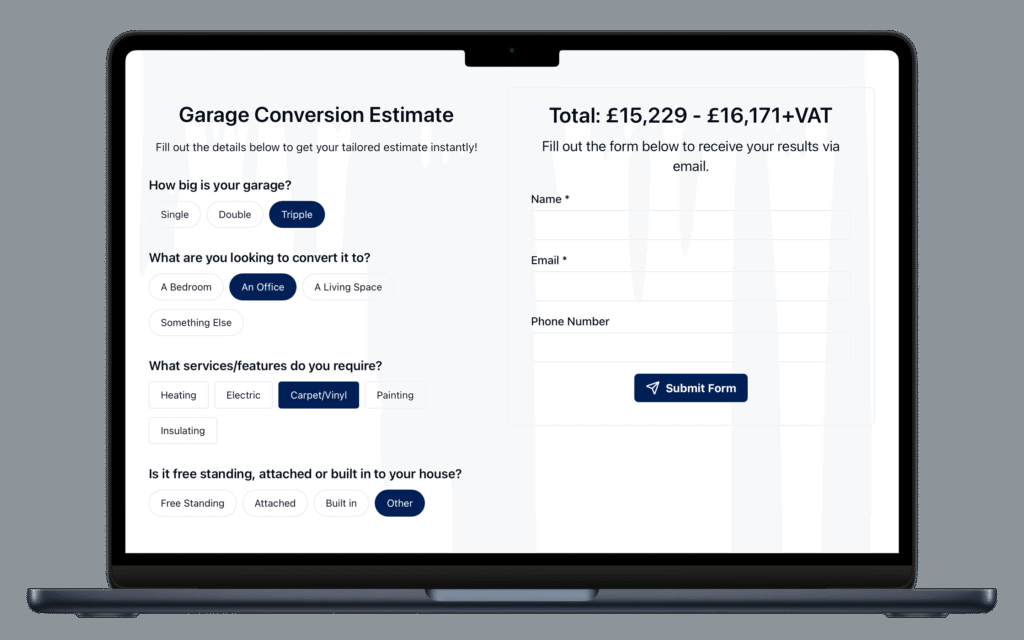
An example of a modern, digital price estimator.
How Does it Work?
At its core, a price estimator is a mathematical equation disguised as a user-friendly form. It typically follows a three-step process:
- Input: The user answers questions (e.g., “How many rooms do you need decorated?” or “How many pages will your website have?”).
- Calculation: The tool applies “weights” to those answers. For example, if “1 Room” equals £400, the tool multiplies the input by that base rate.
- Output: The tool displays a total, often presented as a range (e.g., “£1,200 – £1,500”), to account for unforeseen variables or bespoke requirements.
Why Most Service Business Needs One
1. High-Speed Lead Qualification
A price estimator acts as a 24/7 gatekeeper. If a lead has a budget of £500 and your estimator shows a minimum of £5,000, they likely won’t book a call. This saves you from “price-shock” conversations and keeps your diary clear for serious, qualified prospects.
2. Building Immediate Trust
Transparency is a competitive advantage. By providing a price estimate upfront, you signal to the customer that you are honest about your costs and confident in your value. In the UK market, where consumers often find talking about money awkward, this transparency is highly valued.
3. Increased Conversion Rates
Psychologically, users are more likely to engage with an interactive tool than a wall of text. Once a user spends 60 seconds “building” their project in your calculator, they have already begun to mentally “own” the service, making them more likely to submit their email address to save the result.
Common Examples
- Home Services: A “Kitchen Refurbishment Calculator” where users select square footage, worktop materials, and appliance grades.
- Software & Tech: A “SaaS Pricing Estimator” based on the number of users and data storage requirements.
- Creative Agencies: A “Branding Estimator” that adjusts based on how many concepts, revisions, and brand guidelines are required.
- Freelance Web Developers: A “Project Calculator” that adds costs for e-commerce functionality, SEO setup, or custom integrations.
In Summary
A price estimator is more than just a calculator; it’s a sales representative that never sleeps.
It bridges the gap between a customer’s curiosity and their decision to buy, providing clarity in a world where “Price available upon request” is becoming an outdated barrier to entry.
It’s not designed to necessarily replace sales executives or client meetings, but to make sure that when a meeting or call in taken, expectations are set regarding budget and project scope.