Counselling & Therapy quote template
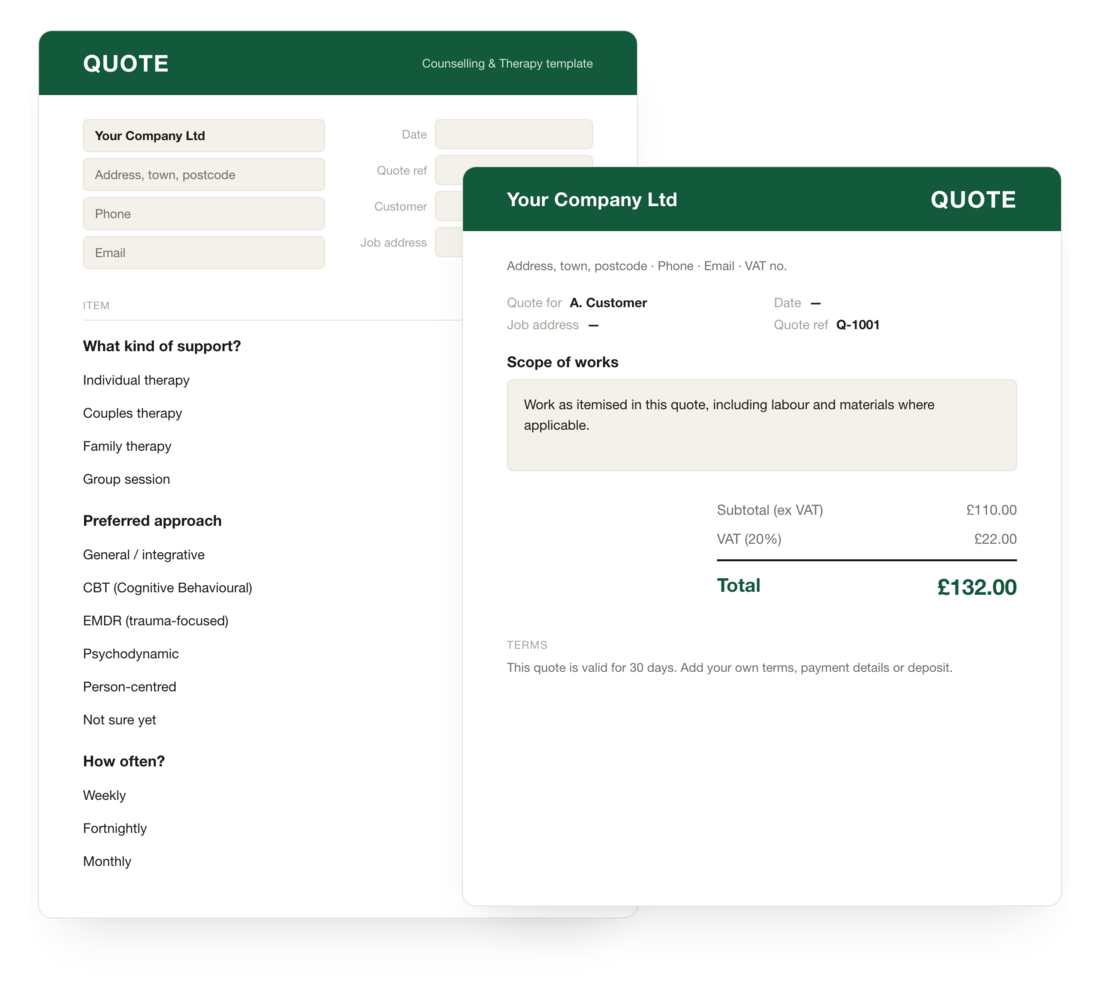
Individual, couples and family therapy across approaches — online or in person.
 Just want the spreadsheet? £7
Excel with the pricing built in, plus a printable PDF. No account needed.
Just want the spreadsheet? £7
Excel with the pricing built in, plus a printable PDF. No account needed.
Not a screenshot
Nothing's submitted — pricing recalculates on every answer, exactly as a customer would see it. Open full screen →
Therapy pricing is a careful balance — too opaque and prospects bounce; too prominent and it feels transactional. This template handles the variables (session type, approach, frequency, format, length) in a respectful, structured form so prospects can see what they're committing to before they book a discovery call.
A purpose-built counselling and therapy quote template that handles individual work, couples therapy, family sessions and group work across multiple therapeutic approaches. Built for private therapists who get a steady stream of "how much for a session?" enquiries and want a structured way to answer them without an awkward fee conversation in the first email.
Private therapists in solo practice, counselling clinics taking enquiries for a team of practitioners, and online-only therapy practices. Works for everything from a single 50-minute session to a 12-week trauma programme.
What the form asks
6 questions by default, branching where the job needs it. Extend with any of Quotify's supported question types .
Make it yours in three moves
Not quite your trade? Describe your business and Quotify builds you a form from scratch.
Your questions, answered
Last updated 2 June 2026-
01 How should I price therapy sessions?
Most therapists price per session (50 or 90 minutes), with surcharges for couples or family work, and discounts for booking blocks of 6 or 10. The Quotify template handles this with a session-length radio, a session-type question (individual / couples / family / group) and optional package add-ons, so the price moves as the prospect adjusts each.
-
02 Can I list different therapeutic approaches in the form?
Yes, and you probably should. The template includes a 'Preferred approach' question (CBT, EMDR, psychodynamic, person-centred, integrative, 'not sure yet') so prospects who know what they're looking for can self-select, and those who don't can ask. Knowing the approach up front saves a discovery email.
-
03 How do I handle online vs in-person without double-quoting?
Add a 'How would you like to attend?' radio (online / in-person at clinic / phone). If your in-person rate differs from your online rate, you can apply a modifier per option. Most therapists keep them the same but the structure supports either approach.
-
04 Does the form take payment or book the slot?
Quotify focuses on producing the quote and capturing the lead, not on payment or calendar slots. Once the enquiry lands, you'd confirm the booking through your existing system (Calendly, Acuity, your own booking page). Lots of therapists handle the first session free or use the enquiry as a way to qualify before committing slot time.
-
05 Is this suitable for both private therapy and group sessions?
Yes. The 'What kind of support?' question includes 'Group session' as an option which can route to a different price tier (typically lower per-person but with a minimum group size). For a primarily group-based practice, you could swap the default order so group is the first option.
-
06 Is there a downloadable counselling & therapy quote template?
Yes. As well as the free online version, you can buy the counselling & therapy quote pack as a spreadsheet for £7. It opens in Excel, Google Sheets or Apple Numbers, with the pricing maths already built in and a branded quote you can export to PDF. Buy once and it's yours to keep.
Start from our Counselling & Therapy template.
14-day free trial. No card required.
Use this template →