

As Quotify relaunches I’m going to share my views as the founder from the initial build to the rebuild to relaunching and beyond.
I’ll be sharing the highlights and the struggles along the way. Stay tuned!
The concept
Just before I discuss the original build and subsequent rebuild, I want to take a moment to look at the core concept of Quotify.
My vision for Quotify is simple: to improve pricing transparency between customers and businesses.
And as a welcome side effect, it helps businesses generate better qualified leads.
For too long, businesses have shied away from sharing their pricing - even just rough guide pricing.
Back in 2021, I was trying to get a price for converting my garage into an office. It felt impossible.
I wasn’t looking for a detailed quote, just a ballpark figure so I could gauge whether it was a realistic goal for our budget, or if we needed to save more. Were we talking £2k? £5k? £10k? £20k? £50k!?
Of course, I fully appreciate there are loads of variables in something like a garage conversion, and that’s exactly where the idea for Quotify came from. I wanted to give businesses the tools to share their pricing elegantly and clearly.
While the concept behind Quotify has stayed constant, the technology has changed, and with good reason…
The original build
I originally built Quotify back in 2021 on WordPress as an MVP (Minimum Viable Product).
Running Prystine Web Solutions, a WordPress development agency, WordPress seemed like a natural choice. I was (still am) very familiar with the platform. It’s flexible and I was confident I could build out the necessary functionality.
So I created a custom theme, with various php templates and more jQuery than I’d like to admit.
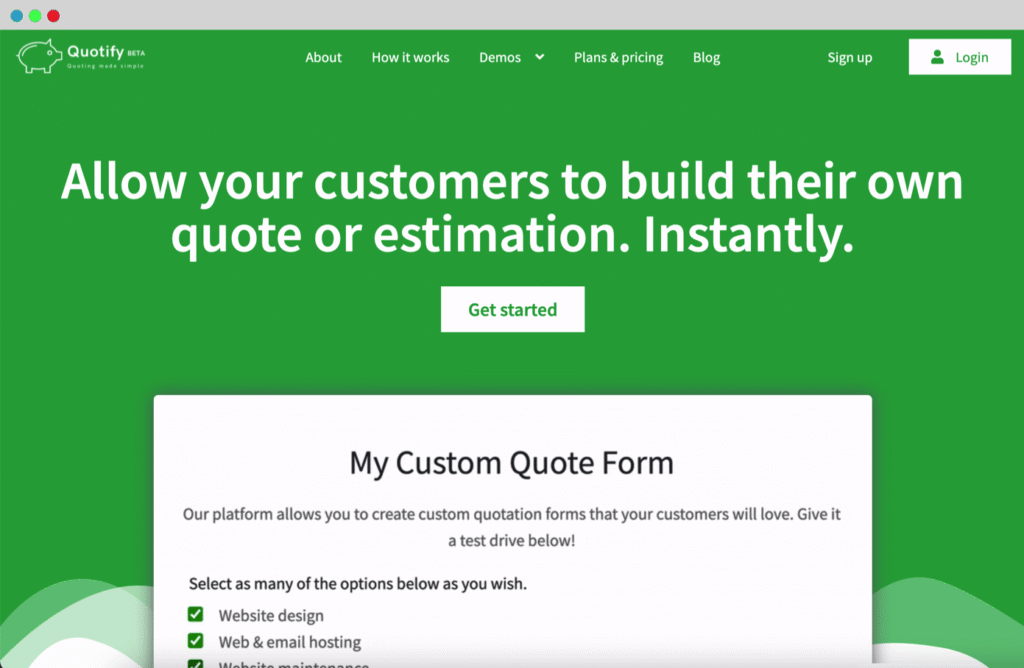
The original Quotify HP from 2021.
But it worked. It launched. And organically, it grew quite nicely reaching several hundred (free) users in the first year, with very little marketing or intervention.
It’s worth noting that a good portion of those users were spam accounts… I had to tighten the onboarding process six months into the project, but not quite to the level of X’s onboarding!
So yes, it was working - sort of. I had a steady trickle of users. So… why the rebuild?
The rebuild
The rebuild was partly a technical decision, but mostly a learning opportunity.
I wanted to learn more about modern tech stacks, namely React, one of the most popular JS libraries around, and one in which WordPress & WooCommerce are steadily adopting.
After completing one of Mosh Hamedani’s courses in React (which I highly recommend) I was ready to jump into a real life project. Because let’s be honest, you only truly learn by building.
So, like many indie hackers, I was faced with the classic question: what should I build?
Rebuilding Quotify just made sense. It was a solid foundation and something I cared about.
I did a bit of digging on Reddit and saw that Next.js, a framework built on top of React, was gaining serious traction, especially for fullstack use cases (handling both frontend and backend).
So I dove into learning and building with NextJS.
It’s been a proper deep end experience. This was my first real project with Next, and I’ve spent more late nights than I care to count debugging, Googling, crawling through docs, and consulting ChatGPT.
But I made it through.
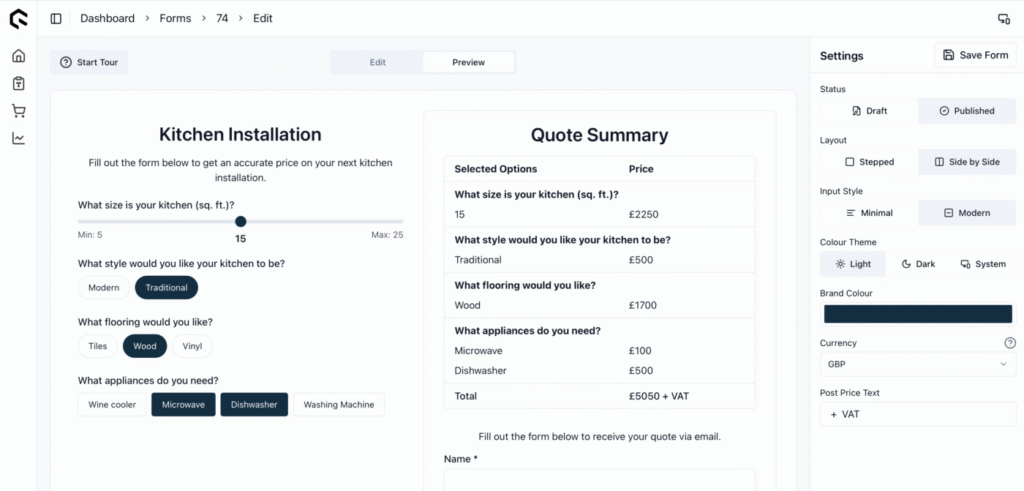
Snapshot of the new Quotify form builder in action.
And what I’ve now got is a very solid foundation, something that Quotify can genuinely build and scale from.
Want me to go into more details about the libraries used and the decisions made during development? Drop me a message.